2026-10-12
Textile Manufacturer Website India: Essential Specs Buyers Verify
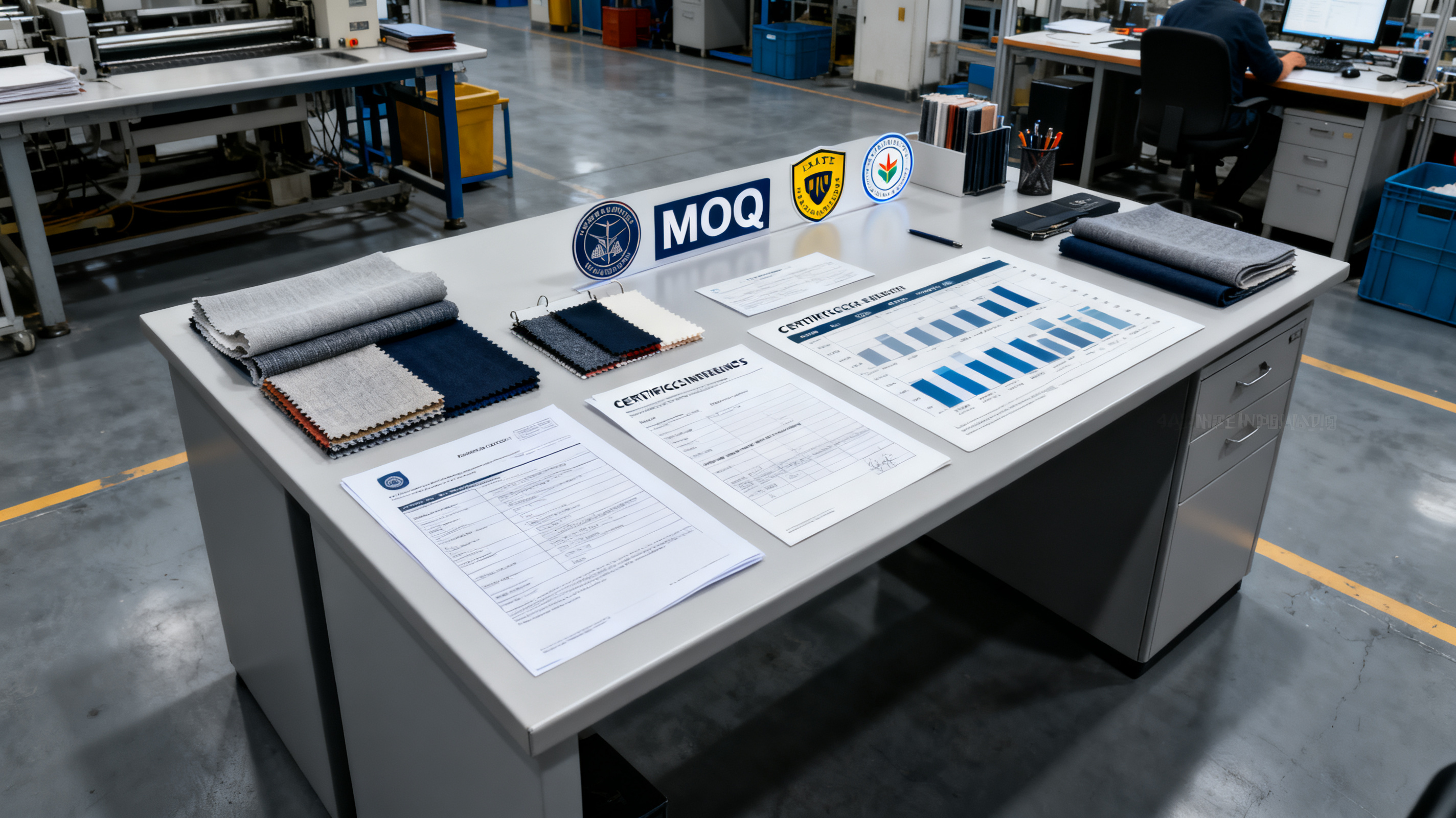
When an overseas buyer lands on a textile manufacturer website india, they scan for specific data points within seconds—fabric composition, minimum order quantity, shipping certifications, and clear production imagery. If those details are buried, vague, or missing entirely, the browser tab closes and the inquiry goes to a competitor who made the same information easy to find. This guide walks through the exact specifications, certifications, and production signals that export buyers verify, so Indian textile manufacturers can structure their pages for trust and inquiries rather than just a digital brochure.
What Buyers Check on an Indian Textile Manufacturer’s Website
Buyers sourcing from India typically follow a mental checklist shaped by years of dealing with inconsistent supplier pages. On a textile manufacturer website india, they look for five things in roughly this order: product specifications with measurable values, visible certification logos or certificate numbers, clear MOQ and pricing ranges, production floor evidence, and contact options that don't require filling a long form. A 2023 survey by the International Trade Centre found that 67% of apparel importers abandon a supplier's website if technical specifications are incomplete or formatted as a scanned PDF rather than readable HTML.
What trips up many Indian export desks is treating the website as a company introduction. Buyers have already seen the "established in 1995" story on fifty other tabs. They want verifiable specifics: the exact GSM range you run on your circular knitting machines, whether your dyehouse handles reactive or disperse dyes, and which countries you've shipped to in the last twelve months. List these plainly. A procurement manager at a German workwear brand or a Dubai trading house does not need poetic descriptions of Indian textile heritage—they need machine gauges, lab test reports, and lead times.
Fabric Specifications Export Buyers Expect to See
Vague product labels like "cotton fabric" or "polyester blend" signal to buyers that the manufacturer either doesn't understand export expectations or is hiding quality limitations. Each fabric listing should include a consistent spec sheet format. Below are the fields experienced export buyers look for, with the reason each one matters:
- Fiber composition (percentage breakdown) — Determines tariff classification codes and whether the fabric qualifies under a free trade agreement. A 98/2 cotton-spandex blend carries different duties than 95/5.
- GSM (grams per square metre) or oz/yd² — The single most searched numeric spec. A buyer sourcing shirting knows they need 110–130 GSM; listing only "lightweight" loses them.
- Weave or knit type — Plain, twill, satin, jersey, interlock, rib. This tells the buyer whether your production line matches their garment pattern requirements before they ever send an email.
- Width (in inches and centimetres) — Affects cutting efficiency and fabric utilization. Buyers calculate wastage from width; hiding it wastes their time.
- Yarn count (Ne or tex) — For woven fabrics, this signals fineness and hand feel. A buyer sourcing sheeting expects 40s–60s Ne; listing the count filters serious inquiries.
- Finishing treatments — Mercerized, sanforized, water-repellent, anti-microbial, flame-retardant. Many buyers search by finishing treatment as a hard requirement for compliance with end-market regulations.
- Colour fastness and shrinkage test results — Stating "lab-tested" without numbers is meaningless. Include values: colour fastness to washing (ISO 105-C06 grade 4), shrinkage below 3% after three washes at 40°C.
A structured HTML table with these fields on each product page also helps search engines surface your fabrics for long-tail buyer queries—someone searching "180 GSM cotton interlock fabric width 72 inches India" is a high-intent lead, and your page can match that query only if the data exists as text, not inside an image or a PDF.
| Specification Field | What Buyers Verify | Common Mistake on Indian Manufacturer Sites |
|---|---|---|
| GSM | Matches garment category requirements | Describing as "medium weight" instead of listing 180 GSM |
| Width | Fits cutting table and pattern layout | Listing only inches, omitting centimetres for EU buyers |
| Fibre blend % | Determines import duty and labelling compliance | Writing "cotton-rich" without exact percentage |
| Shrinkage | Affects garment sizing after consumer wash | Saying "pre-shrunk" without test result figures |
Certifications and Compliance That Matter for Indian Textile Exporters
Buyers from the EU, North America, and Japan increasingly treat certifications as a first-pass filter. If the required certification isn't visible on a textile manufacturer website india, they may not even send the inquiry. The specific certifications that matter depend on your target market and product category, but several carry weight across most segments.
OEKO-TEX Standard 100 is the baseline for any manufacturer exporting fabrics that touch skin. Buyers check the certificate number and validity date; many verify it directly on the OEKO-TEX online directory. If your certificate is current, display the logo with a link to the verification page rather than just stating the certification in text. For organic cotton or natural-fibre textiles, GOTS (Global Organic Textile Standard) certification is non-negotiable for EU organic claims. The certification scope matters—buyers check whether your GOTS covers only fabric production or extends to dyeing and finishing as well.
Social compliance certifications such as SA8000, BSCI, or SEDEX SMETA audit reports are increasingly requested by European brands. Even if you don't hold these, stating that your factory is auditable and listing any completed social audits builds confidence. For technical textiles aimed at industrial buyers, ISO 9001 for quality management and ISO 14001 for environmental management signal process maturity. Indian manufacturers supplying the US market should highlight FTC labelling compliance knowledge—buyers want to know you understand the Textile Fiber Products Identification Act before they place a trial order.
Production Details and MOQ That Build Buyer Confidence
Export buyers view a manufacturer website as a pre-qualification tool. The production section of an Indian textile manufacturer's site should answer whether your minimums, lead times, and capacity match their sourcing needs—before anyone exchanges an email. When a textile manufacturer website india buries MOQ behind a "contact us" button, the buyer assumes the minimums are too high for small-brand orders or too low for large-volume buyers, and both assumptions cost inquiries.
State MOQ per product category explicitly. "MOQ: 500 metres per colour for knitted fabrics; 1,000 metres for woven" is far more useful than "MOQ negotiable." Buyers sourcing for boutique brands or pilot runs specifically search for manufacturers offering low MOQs of 200–300 metres, and they filter out sites that don't list a number. For larger bulk buyers, listing annual production capacity in tonnes or metres per month helps them assess whether you can handle a 40-foot container order without subcontracting.
Include these production-floor signals on the website, ideally with dated photos rather than generic stock imagery:
- Machine list with counts and gauges — "12 circular knitting machines, 24-32 gauge, 26-34 inch diameter" tells a buyer more than "state-of-the-art machinery."
- In-house vs outsourced processes — Be honest about which stages you handle internally (knitting, weaving, dyeing, printing, finishing, packing) and which go to partner units. Buyers verify this during factory audits anyway.
- Sampling policy and timeline — State whether you offer free sampling for serious inquiries, the typical turnaround (5-7 days, 10-14 days), and whether you ship via DHL/FedEx or buyer's courier account.
- Export countries served — Listing "shipped to Germany, France, UAE, and Australia in 2024" with approximate shipment counts gives buyers a quick trust anchor. It also helps them guess whether you understand their market's labelling and packaging requirements.
Lead times should be stated as a range with the variables that shift them: "Standard lead time 21-28 days for repeat orders under 5,000 metres; add 7-10 days for first-order lab-dip approvals." This specificity tells the buyer you run a real production schedule, not a trading desk that will scramble after receiving the PO.
FAQ
What technical details do overseas buyers check first on an Indian textile manufacturer's website?
Buyers scan for GSM, fibre composition percentage, fabric width in both inches and centimetres, and weave or knit type. If those four data points are missing from a product page, most professional buyers move to the next supplier tab within 10-15 seconds. The rise of reverse image search also means buyers cross-check product photos against marketplace listings to gauge whether the manufacturer is genuine or a reseller.
Do small textile mills in India need GOTS or OEKO-TEX to receive export inquiries?
For basic commodity fabrics, some buyers will inquire without certifications if the price and specs are competitive. However, any buyer sourcing for the EU market or for brands with sustainability commitments will require at minimum OEKO-TEX Standard 100. Displaying the certification logo with a valid certificate number and a link to the public verification directory increases inquiry-to-sample conversion measurably. If certification is in progress, state the expected completion date rather than staying silent.
How should MOQ be presented so it doesn't scare off smaller buyers?
List a tiered range: a lower MOQ for stock colours or greige fabrics, and a higher MOQ for custom dyed or printed orders. For example, "MOQ 300 metres for stock white/black; 800 metres for custom Pantone dyeing." This signals flexibility without losing large-volume buyers who want to know you can scale. If you offer sampling yardage at a surcharge, mention that as a separate line—small brands often start with sample-length purchases.
What common website mistakes cause Indian textile export sites to lose buyer trust?
Generic stock photos of a factory floor that don't match the actual production setup, PDF catalogues that require download instead of readable on-page specs, no mention of export countries served, and hidden MOQ behind a contact form are the four most frequent trust-killers. Also, a website that loads slowly on a buyer's mobile connection in Istanbul or Lagos—common when product images are unoptimized—can cause a 4-7 second delay that drops inquiry rates significantly. Google's Core Web Vitals research shows that pages meeting the "good" threshold for Largest Contentful Paint retain visitors at nearly twice the rate of those that don't.
Is it worth listing export shipment ports and logistics partners on a textile manufacturer website in India?
Yes. Stating your primary shipment port (Nhava Sheva, Mundra, Chennai, Tuticorin) and typical FOB terms helps buyers calculate landed costs before they contact you. Mentioning logistics partners like Maersk, MSC, or a familiar freight forwarder reassures buyers that you handle documentation and container booking professionally. For buyers in the Middle East and Africa who work with consolidators, knowing the port of loading determines whether your shipment route matches their existing consolidation schedule.
References & Further Reading
- B2B Frontage Blog — guides on manufacturer website structure
- OEKO-TEX — verify certificate numbers and understand Standard 100 requirements
- Global Organic Textile Standard (GOTS) — certification scope and recognised auditors
- web.dev — Core Web Vitals and how page speed affects user trust and conversion
- Google Search Central — Product structured data for surfacing specs directly in search results