2026-10-12
The RFQ Process for Electronic Components: A Buyer’s Guide
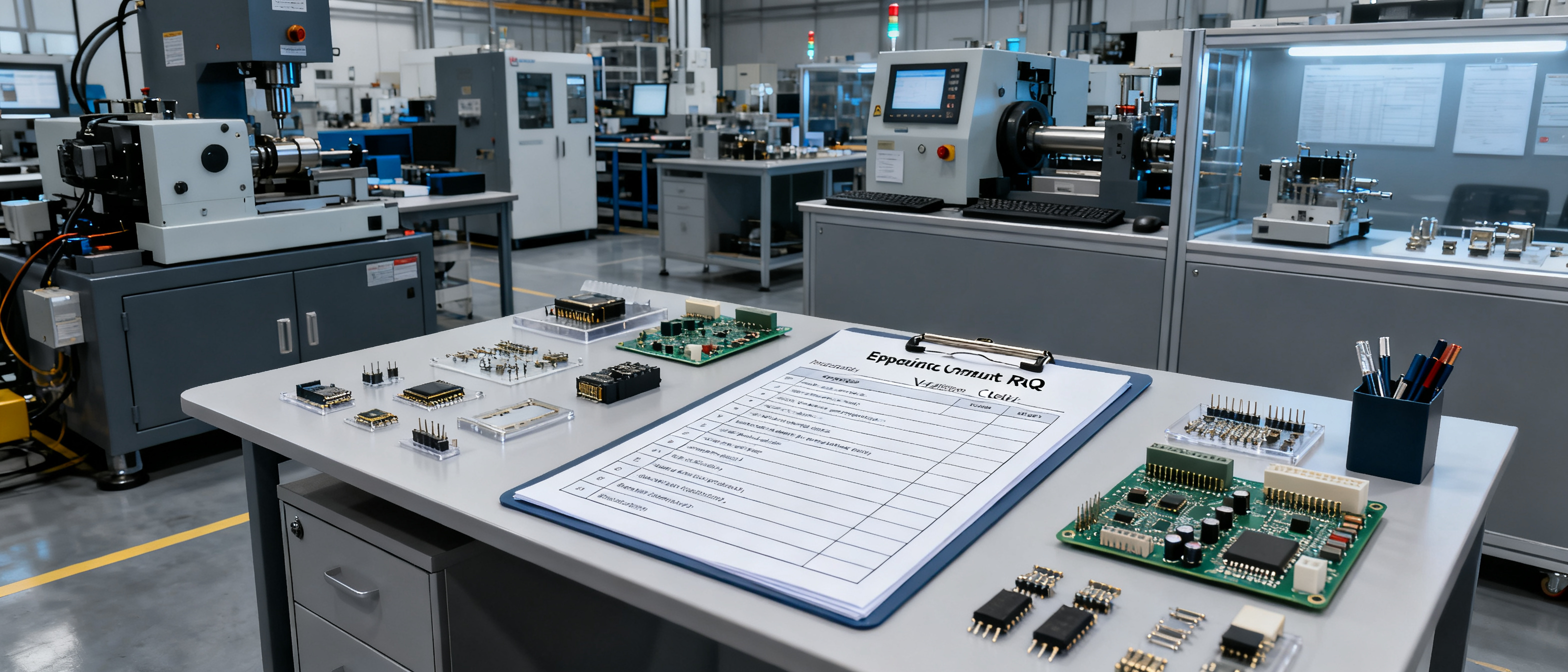
Understanding the RFQ process for electronic components saves procurement teams from costly missteps: counterfeit parts, nonconforming batches, and suppliers who look legitimate until payment clears. An RFQ (Request for Quotation) in electronics isn't a generic price inquiry — it captures part numbers, manufacturer restrictions, date codes, packaging requirements, and compliance documents before a single unit ships. This guide walks through what a solid electronics RFQ contains, how to verify a supplier before you send one, and what the evaluation side looks like once quotes land.
What an RFQ for Electronic Components Includes
An electronics RFQ differs from RFQs in fabricated metals or packaging because the item identity is binary — you either receive the exact MPN (Manufacturer Part Number) or you don't. Ambiguity gets expensive. A component RFQ typically bundles:
- Full MPN and manufacturer name — never just a generic description like "STM32 microcontroller." Specify STM32F407VET6, package LQFP-100, and whether alternate sources are acceptable.
- Quantity and delivery schedule — one-time buy, scheduled releases over 12 months, or blanket PO with call-offs. Lead time expectations belong here too.
- Date code and revision requirements — many buyers reject parts older than 2 years from the date code or require a specific silicon revision. Without this, suppliers can ship old inventory that fails burn-in.
- Packaging and labeling spec — tape-and-reel, tray, tube, moisture-sensitivity level (MSL) handling, ESD requirements, and whether reels must conform to EIA-481.
- Compliance and documentation — RoHS, REACH, IPC Class 2 or 3, full-form Certificate of Conformance (CoC), test reports for high-reliability applications, and sometimes PPAP (Production Part Approval Process) for automotive-grade components.
- Terms and incoterms — FOB, EXW, DDP, payment terms, and whether inspection rights apply before shipment.
- Traceability requirements — for aerospace and medical, buyers frequently demand lot-level traceability back to the wafer fab.
Skimping on any of these fields produces quotes that aren't comparable. One supplier quotes reeled parts with full CoC; another quotes loose tray parts with a "trust us" email. You can't evaluate them side by side.
What to Include in an Electronic Component RFQ
Structuring the RFQ process for electronic components well means front-loading information so suppliers don't need three rounds of clarification. Here is what procurement desks with repeatable results include in the request itself:
- Line-item table with mandatory columns: MPN, manufacturer, quantity, target price (optional but speeds rejection), acceptable alternates (yes/no), date-code floor, and delivery window. Avoid PDFs that require retyping — Excel or a structured web form reduces errors.
- Quality clauses: reference IPC-A-610 acceptability standards, state whether independent testing (e.g., X-ray, decapsulation, solderability) is required, and define who pays for it. For high-risk components, specify that parts will be inspected per IDEA-STD-1010 or AS6081.
- Obsolescence and EOL policy: ask the supplier to flag if a part is NRND (Not Recommended for New Design) or has a published EOL notice. This single field prevents production-line surprises six months later.
- Warranty and returns: state the window (commonly 90 days to 1 year), the process for RMAs, and who covers return shipping for non-conforming parts. If the supplier knows you enforce this, they self-filter.
- Confidentiality note: a short paragraph that the RFQ is proprietary and not to be shared with competitors or brokers without written consent. Not legally bulletproof, but it signals seriousness.
The RFQ itself doubles as a supplier-filtering tool. Suppliers who push back on traceability or date-code requirements are telling you something about their inventory source before you spend a dollar.
How Procurement Verifies a Supplier Before Requesting a Quote
Sending an RFQ to an unverified supplier is how counterfeit components enter the supply chain. In electronics, the verification step is not optional — it's the difference between a working production line and a line-down event that costs $50,000 per hour in some plants. Procurement teams with mature RFQ processes run a short checklist before inviting a supplier to quote:
| Check | What to look for | Red flags |
|---|---|---|
| Business registration | Active company registration matching the name on the quote; physical address that isn't a virtual office | Registered 3 months ago; address resolves to a residential unit or mail-forwarding service |
| Authorized distributor status | Franchise authorization from the manufacturer (verify on the manufacturer's website, not just a logo on the supplier's site) | "We can source anything" from a supplier claiming authorized status across 50 brands |
| Quality certifications | ISO 9001 at minimum; AS9120 or AS6081 for aerospace; ESD S20.20 for handling. Validate certificate numbers on the certifying body's database. | Certificates that expired 18 months ago; "self-certified" claims; cert number doesn't resolve |
| Testing and inspection capability | In-house or contracted lab for X-ray, decapsulation, XRF, solderability; willingness to provide a recent test report for a similar part | "We visually inspect all parts" as the only answer when you ask about counterfeit detection |
| Trade references | Two or three verifiable buyers who purchased similar components in the last 12 months | References that are unreachable, overly generic, or from a different industry entirely |
| Online footprint and marketplace history | Consistent company name across platforms; multi-year transaction history; clear specialization rather than "all industries" | Website registered last month; no HTTPS or a domain privacy shield hiding every detail; identical boilerplate text across three different supplier directories |
For franchised distributors, verification is straightforward: check the manufacturer's own "where to buy" page. For independent distributors and brokers, the bar is higher. Resources like ERAI maintain supplier risk ratings and counterfeit component databases that many procurement organizations subscribe to. A supplier who appears on ERAI with unresolved reports should not receive your RFQ.
Document all verification steps. If a batch fails incoming inspection six months later, you'll need to demonstrate that due diligence was performed — especially relevant for buyers operating under AS5553 counterfeiting avoidance requirements.
The RFQ Evaluation and Award Process
Once quotes return, the evaluation phase turns on far more than unit price. The goal is total cost of ownership (TCO) across the purchase order lifecycle. Procurement teams commonly weight these factors when scoring electronic component RFQ responses:
- Unit price and total landed cost — including freight, duties, and any bank transfer fees. A $0.08 part with $300 in wire fees and $500 in air freight can cost more than a $0.12 part from a local distributor with free ground shipping.
- Lead time accuracy — suppliers who consistently deliver within the quoted window (not the optimistic one) are worth a premium. Ask for on-time delivery data for the last 12 months; many reputable distributors track this.
- Documentation completeness — a quote that arrives with CoC, test reports, and traceability paperwork already attached saves the buyer 2–4 hours of chase time compared to one that promises documents "after the PO."
- Warranty and RMA process clarity — a supplier who provides a clear RMA form, expected turnaround, and a named contact for quality issues signals lower risk.
- Financial stability indicators — especially for long-term supply agreements. Dun & Bradstreet reports, credit references, and years in business all factor in.
- Communication responsiveness — suppliers who answer technical questions in hours rather than days during the RFQ phase usually behave the same way during a quality hold.
The award decision isn't always "cheapest wins." In electronics, cheap parts that fail incoming inspection create rework costs, line stoppages, and potential field failures. Many aerospace and medical buyers maintain an approved vendor list and only send RFQs to suppliers on it — the evaluation step becomes binary: pass/fail on technical compliance, then negotiate price within a qualified pool.
For recurring components, some procurement organizations run a quarterly RFQ to test the market — even when an existing supplier is performing well. The goal isn't always to switch; it's to validate that pricing remains competitive and to have a backup source qualified before a shortage hits. In the 2020–2022 component shortage cycle, buyers who had pre-qualified alternates were the ones who kept production lines running.
After award, the PO should reference the RFQ by number and attach the winning quote as a contractual exhibit. This ties the supplier's promises — date codes, packaging, compliance — to the purchase agreement so there is no ambiguity during incoming inspection.
FAQ
What's the difference between an RFQ, RFP, and RFI in electronics procurement?
An RFI (Request for Information) is preliminary: you're asking suppliers to describe their capabilities, certifications, and typical lead times without committing to pricing. An RFP (Request for Proposal) asks for a solution to a problem — common when a design team needs a substitute for an EOL component and wants suppliers to propose functional equivalents. An RFQ (Request for Quotation) is transactional: you know the exact part and quantity; you're asking for a price and delivery commitment. In electronics, RFQ is the most common because components are standardized — you rarely need a proposal for an STM32 or an MLCC capacitor.
How long does the RFQ process for electronic components typically take?
From issuing the RFQ to awarding a purchase order, 3 to 10 business days is typical for standard components from known suppliers. Complex RFQs with hundreds of line items, alternate-part evaluations, or new supplier verification can stretch to 3–4 weeks. The biggest time sinks are: incomplete RFQs that require clarification rounds (2–5 days each), supplier verification for unknown trading companies (1–2 weeks if certification checks are involved), and internal approval workflows. Buyers who use structured RFQ templates and pre-verify suppliers routinely close the cycle in under a week.
Should I request samples before awarding an RFQ?
For components that will be assembled by a contract manufacturer or used in safety-critical circuits, yes — but with a process. Request 5–25 sample units from the short-listed supplier(s), document the date code and lot number, and run incoming inspection (visual, X-ray if risk is high, and functional testing on a known-good test board). Samples should come from the same inventory the supplier plans to ship — not a "golden sample" from a different batch. Many buyers make sample approval a condition before the PO is released, especially for independent distributors and broker-sourced parts. Be prepared to pay for samples; reputable suppliers who see a genuine RFQ will often provide them at no charge or at cost.
How do I handle RFQs for obsolete or hard-to-find components?
When a part is EOL or on allocation, the RFQ process shifts. Instead of a standard quote, specify that you're open to independent distributors and authorized aftermarket sources. Add fields for: the specific date code range you'll accept, whether re-balled or refurbished parts are allowed (usually no for high-reliability), and a requirement for authenticity testing with a third-party lab report. For obsolete components with no authorized source, some buyers use a two-stage RFQ: Stage 1 asks suppliers to confirm they have authentic inventory with traceability documentation; Stage 2 sends the full RFQ only to those who pass Stage 1. This saves time and avoids collecting unusable quotes from brokers who claim they "can find it" but can't back it up.
References & Further Reading
- ERAI — Supplier risk ratings and counterfeit component reporting
- web.dev — Evaluating digital signals of supplier credibility (HTTPS, domain age, structure)
- Google Search Central — How search visibility relates to legitimate business presence online
- IPC Standards — IPC-A-610, J-STD-001, and related acceptability standards for electronic assemblies
- SAE AS5553 — Counterfeit electronic parts avoidance standard (aerospace)
- B2B Frontage Blog — More procurement and supplier presence guides