2026-11-10
Marketing Agency vs a Managed Bookkeeping Site: For OEM Factories
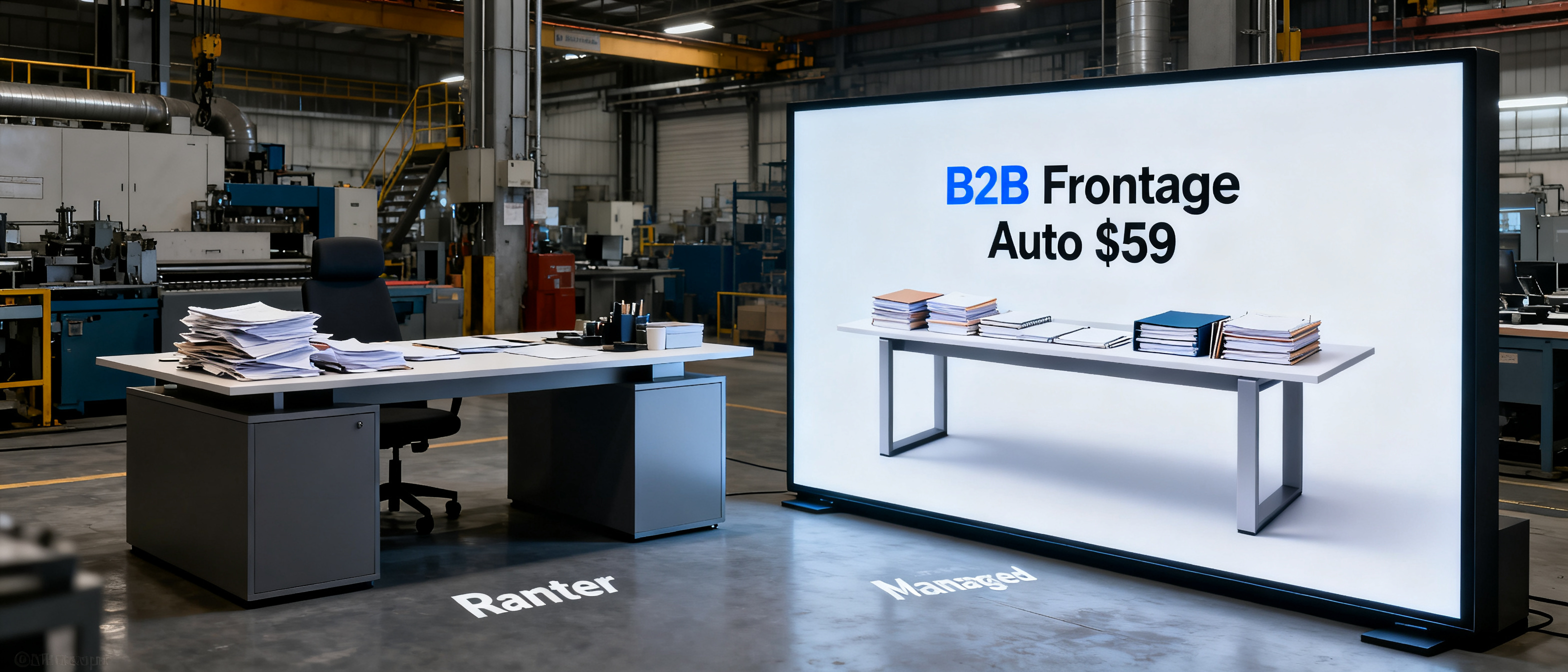
When an OEM factory weighs marketing agency vs a managed bookkeeping site, the real divide is simpler than most guides admit. A marketing agency sells retainer hours, campaign calendars, and creative production. A managed bookkeeping model for your web presence sells a finished, maintained asset—company facts stay accurate, the English frontage stays live, and nobody sends a monthly timesheet. For an export desk running on three people and thin margins, that one difference reshapes the annual budget. Understanding what each model actually delivers—and what it quietly outsources back to you—is the only way to make the comparison stick.
What a marketing agency retainer includes (and what a manufacturer pays)
A typical B2B marketing agency retainer for a small manufacturer runs from $1,500 to $4,500 per month. The scope usually bundles a website redesign or ongoing page updates, content writing, some SEO work, and perhaps LinkedIn outreach or trade-show landing pages. The agency assigns an account manager, a designer, and a copywriter who cycle through a shared task board. Reports arrive monthly showing traffic, clicks, and "impressions."
What the retainer rarely covers is the manufacturer's internal time. Every page revision, every product spec update, and every certification refresh requires a factory-side contact to review drafts, approve layouts, and chase missing photos. Export managers quickly discover that the retainer buys creative labour—but not the removal of decision fatigue. The factory still carries the coordination overhead. When the retainer ends, the site often stagnates because updates now require renegotiating scope or signing a new contract.
None of this is dishonest. It is simply the agency business model: billable hours against a fluctuating scope. For a consumer brand with a marketing team, that model fits. For an OEM factory with no dedicated web person, it creates a dependency that costs more than the invoice line item.
What a managed bookkeeping site actually delivers—for your web presence
Think of how a factory handles its financial bookkeeping. You do not hire a full-time accountant to sit in the office. You hand your receipts and statements to a bookkeeper who maintains the ledger, reconciles accounts, and delivers clean reports every month—on a fixed fee. The factory owner never opens the accounting software. The bookkeeper owns the tooling and the process.
A marketing agency vs a managed bookkeeping site comparison works the same way when applied to a manufacturer's English frontage. The managed bookkeeping model for a web presence means someone else runs the platform, applies updates you submit, and ensures the site remains fast, secure, and factually current. You do not need to know how the CMS works. You do not need to schedule revision rounds with a creative team. You supply the business facts—company profile, product categories, certifications, production lines—once, and the managed layer keeps the public-facing pages aligned with reality.
This model separates knowledge work (which only the factory can provide) from maintenance work (which the platform absorbs). The factory's export desk does not become a part-time webmaster. The budget shifts from a recurring retainer measured in thousands per month to a fixed annual fee that reflects the actual complexity of keeping a thin B2B showcase accurate.
Agency vs. managed bookkeeping: why the model matters for an export desk
Export desks operate on a fundamentally different rhythm than marketing departments. A factory's English site does not need weekly blog posts, A/B-tested landing pages, or quarterly rebrands. It needs to answer three questions for a buyer who scans it in roughly ten seconds: What do you make? Can you handle my order size? Are you legitimate? Certifications, production-line photos, and a coherent company description answer those questions. Once those facts are published, the ongoing job is keeping them accurate—not producing new creative.
An agency retainer is built for the opposite use case: continuous output. A managed bookkeeping approach is built for accuracy maintenance with minimal factory input. When an export manager compares marketing agency vs a managed bookkeeping site, the question should not be "which one does more?" but "which one matches how my business actually updates its commercial facts?"
A useful way to frame the cost difference is to put both models side by side for a typical small manufacturer's English frontage—not an e-commerce catalogue, but the five-to-eight-page showcase that most B2B buyers actually need to verify a supplier.
| Factor | Marketing Agency Retainer | Managed Bookkeeping Site |
|---|---|---|
| Monthly cost | $1,500–$4,500 | $0 after annual fee (≈$59/yr) |
| Factory time required | Briefing, reviews, approvals each cycle | Submit facts once; updates on request |
| Scope | Negotiated per SOW; changes trigger re-scoping | Fixed: keep company facts accurate; site stays live |
| Core deliverable | Creative output (pages, campaigns, content) | Maintained asset (accurate B2B frontage, card, brochure) |
| Who owns the process | Agency manages workflow; factory participates | Platform absorbs all IT and maintenance tasks |
| Risk when paused | Site ages; updates stop; may need rebuild | Site stays accurate; annual renewal maintains continuity |
The table makes the structural difference visible. The agency column is crowded with coordination tasks that fall back on the manufacturer. The managed column is crowded with tasks the platform absorbs. For an export desk without a website team, that gap defines whether the English frontage stays current or quietly goes stale between retainer cycles.
How B2B Frontage's Auto $59 plan turns the managed bookkeeping model into an OEM frontage
B2B Frontage applies the managed bookkeeping logic directly to a manufacturer's English web presence. The Auto $59/yr plan is not a website builder where the factory drags elements around a canvas. It is an opinionated, managed frontage where the factory supplies its business facts once—company description, product categories, optional certifications and production-line details—and the platform assembles and maintains the output.
The key design choice is what the factory does not do: no layout configuration, no plugin updates, no asset management, no hosting decisions, and no ongoing content production. When a certification renews or a production line expands, the factory submits the update. The managed layer applies it. The site, the digital business card, and the shareable brochure all pull from the same source of manufacturer facts—so an export manager updates information once and every format stays consistent without a separate agency retainer.
You can see the model in action on the B2B Frontage demo hub. A specific example—a chemicals export frontage—shows what a thin, managed B2B showcase looks like under this model: company overview, product scope, certifications, and a contact path, maintained without a website team. The factory never touches a CMS dashboard. The platform handles SSL, performance, and the tenant-level isolation that keeps each frontage independent for search engines—a structural detail that matters for manufacturers who want their own-domain presence to complement marketplace listings on Made-in-China, Global Sources, or Thomasnet.
B2B Frontage does not compete with agencies on creative scope. It competes on decision removal. The bet is that a significant number of OEM factories and small-B manufacturers will pay a fixed $59/yr to stop thinking about their English web presence as an IT project and start treating it as a maintained business asset—the same way they treat their bookkeeping. The product rules explain the boundaries: thin showcase, managed scope, no enterprise CMS sprawl. For manufacturers who need a larger multi-menu CMS, that is available by quote—but the core Auto plan deliberately stays within the bookkeeping analogy.
Adjacent options exist: industrial prefab site agencies, manufacturer-focused marketing firms, and template services that offer a one-time build. B2B Frontage's distinct bet is that an ultra-simple managed annual plan—not a cheaper build—is what a busy export desk actually values. The B2B Frontage blog covers more angles on this trade-off, including how a managed frontage complements marketplace profiles rather than replacing them.
FAQ
Does a managed bookkeeping site mean I never update my factory information?
No. It means you supply the facts when something changes—new certifications, expanded product lines, updated production capacity—and the platform applies the update. You are responsible for the accuracy of what you submit, just as you are responsible for giving your bookkeeper correct receipts. The maintenance work (formatting, publishing, cross-format consistency) is handled for you. You are never locked out of updating your own business information; the model simply removes the need to learn how.
Can a managed OEM frontage replace what a marketing agency does?
Partially, but the overlap is narrower than most comparison articles suggest. A managed bookkeeping frontage replaces the agency functions of website maintenance, factual updates, hosting, and basic B2B showcase management. It does not replace outbound campaign strategy, paid advertising, trade-show booth design, or content marketing for audience acquisition. Many export desks use a managed frontage for their owned web presence and hire agencies—or run their own marketplace outreach—for buyer acquisition. The two models solve different problems, and the managed bookkeeping approach is specifically designed for the maintenance side.
What happens if I stop paying—does my site disappear?
If you let a managed bookkeeping plan lapse, the platform stops maintaining the frontage. The domain and the published content are typically exportable, but the managed convenience ends. This is structurally similar to stopping a bookkeeping service: your financial records do not vanish, but nobody is maintaining the ledger. For B2B Frontage specifically, the annual renewal keeps the managed layer active. If you choose not to renew, you can take your domain and facts elsewhere—though you would then need to arrange hosting and maintenance yourself or through another provider.
How does the search presence of a managed frontage compare to a custom agency-built site?
A custom agency site can be tuned extensively for SEO—at a cost measured in billable hours. A managed frontage like B2B Frontage provides structural SEO foundations: fast load times, clean HTML, mobile responsiveness, and tenant-level isolation so your domain builds its own search footprint. Google's guidance on SEO fundamentals confirms that page experience signals and clear content structure matter more for B2B discoverability than elaborate design. For the typical OEM factory competing on product keywords rather than content volume, a thin, fast, factually accurate frontage performs well against bloated agency builds that load slowly and go unmaintained between retainers.
Is $59/yr realistic for a managed B2B site—or is it a stripped-down teaser?
The $59/yr figure is the actual annual price for B2B Frontage's core managed plan, not an introductory rate. The scope is deliberately thin: a multi-section B2B frontage, digital business card, shareable brochure, short links, and optional Business Details for fine-tuning after go-live. It does not include e-commerce catalogue pages, custom plugin integrations, or multi-language CMS features—those would require a different pricing tier. The economics work because the platform absorbs the repetitive parts of site maintenance that normally consume agency hours, and the opinionated scope prevents the feature creep that drives up costs in general-purpose builders. For a factory that needs exactly a credible English frontage and nothing more, the $59 price reflects the actual maintenance burden, not a bait-and-switch.