2026-09-14
IndiaMART vs Having Your Own Website: Why Export Buyers Ask for Yours
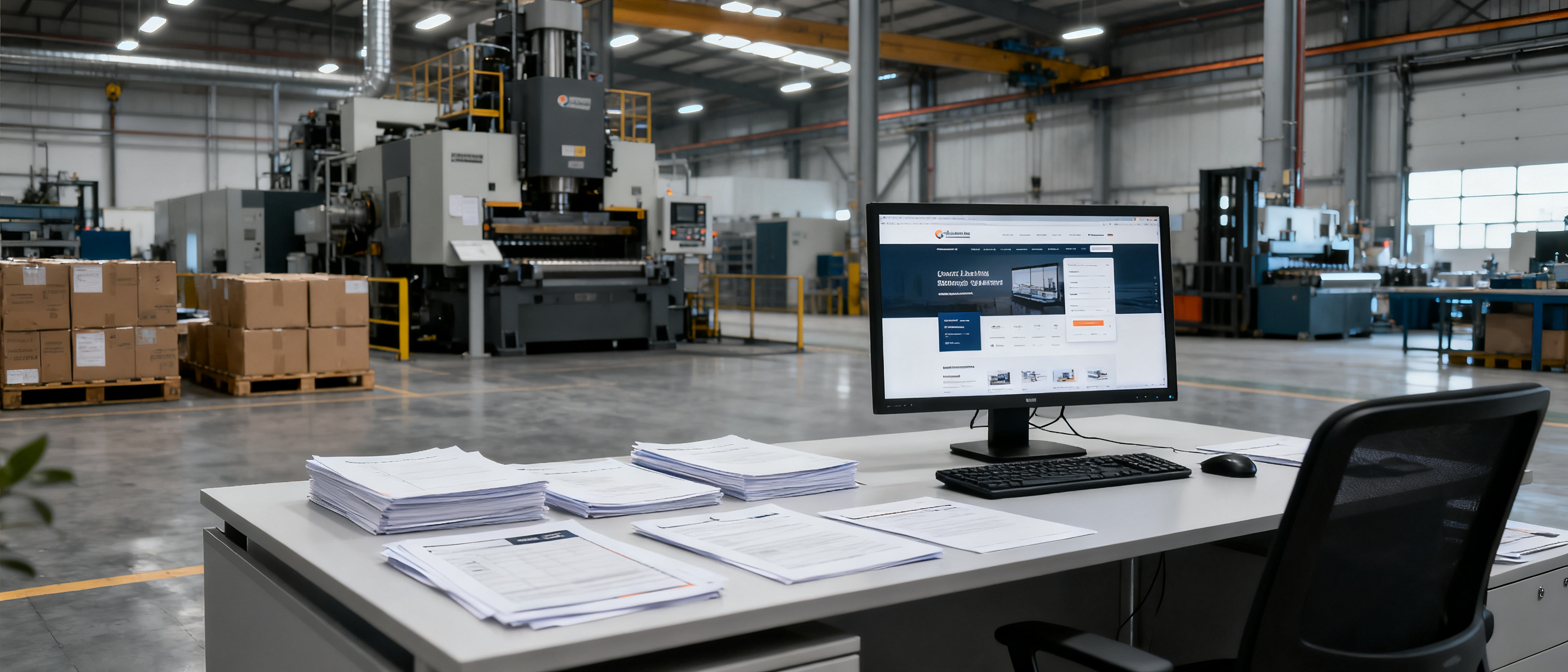
When a procurement manager finds your company on IndiaMART, the first thing they do after scanning your product listing is search for your own website. The question of indiamart vs having your own website is not about choosing one over the other — it is about understanding that the marketplace initiates discovery, while the own-domain site closes the trust gap that leads to an RFQ. Without a manufacturer website that a buyer can bookmark, forward to a colleague, and verify independently, even a well-optimised IndiaMART or EC21 profile leaves serious inquiries unconverted.
What Buyers Really Check After a Marketplace Match
Export buyers who source through IndiaMART or EC21 follow a surprisingly consistent verification sequence once a supplier catches their attention. Their behaviour is shaped by years of dealing with trading companies posing as manufacturers, inflated certifications, and product photos recycled across a dozen listings.
The typical post-match workflow looks like this:
- Google the company name. Buyers want to see whether a legitimate business exists beyond the marketplace. A missing or poorly maintained own-domain site is the single largest red flag — worse than a thin product catalogue.
- Check domain age and SSL. A site that looks six months old with no HTTPS raises immediate concerns about the company's stability.
- Look for a physical address and factory photos. Not stock photography — real images that match the production capability claimed in the IndiaMART listing.
- Read the "About" or company page. Buyers are scanning for narrative consistency: do the years in business, certifications, and production lines match what the marketplace profile states?
- Forward the site link internally. In mid-sized buying organisations, the procurement lead sends promising supplier URLs to quality and engineering teams. A marketplace URL rarely gets forwarded with the same weight as a dedicated domain.
This sequence takes under 30 seconds. If your own site is missing or looks abandoned, the buyer moves to the next shortlisted supplier — often without sending a single inquiry.
Why a Marketplace Profile Alone Often Fails to Convert Serious RFQs
IndiaMART, EC21, and similar B2B directories are built for discovery, not for closing. Their incentive is to keep buyers searching within the platform, comparing suppliers side by side, and clicking on paid listings. A supplier profile on these platforms is effectively a shop window in a crowded bazaar — visible, but surrounded by competitors who can undercut your price with one click.
Three structural limitations of marketplace-only presence explain why export desks see RFQ conversion drop without an own-domain site:
1. Forwardability is broken. When a procurement manager sends an IndiaMART product URL to a quality engineer, the recipient lands on a page cluttered with competitor listings, platform navigation, and upsell prompts. The supplier's credibility is diluted by the platform's own branding. An own-domain product or solutions page presents the manufacturer's story without anyone else's noise.
2. Verification asymmetry favours competitors who own their domain. In a shortlist of five suppliers — four with their own English showcase sites and one relying solely on an EC21 profile — the domain-owning suppliers are consistently perceived as more established, regardless of actual factory size. Buyers have told us directly: "If they cannot maintain a basic company page, I worry about their attention to quality."
3. RFQ forms on marketplaces route through platform infrastructure. Buyers who prefer direct email or WhatsApp communication may abandon an inquiry if the only contact path is a marketplace message centre. An own-domain site gives you control over contact channels — email, phone, messaging app — without a platform intermediary potentially filtering or delaying the lead.
These limitations do not make IndiaMART or EC21 useless. They make them incomplete as a standalone export strategy.
EC21, IndiaMART, and the Shared Trust Gap
The trust gap is not unique to IndiaMART. It is structural to every B2B directory that aggregates thousands of suppliers under one domain. EC21, based in Korea, serves a different geographic buyer base but suffers from the same problem: buyers cannot distinguish a three-person trading desk from a 200-employee production line using only the platform's built-in verification badges.
Consider the reality of platform verification:
| Trust Signal | IndiaMART | EC21 | Own-Domain Site |
|---|---|---|---|
| Supplier verification | TrustSEAL / Aadhaar-based | Basic email/phone check | Consistent company narrative, real photos, certs visible |
| Buyer-seller direct contact | Platform message centre, then phone/email | Inquiry form routed by platform | Direct email, WhatsApp, phone — no intermediary |
| Competitor adjacency | High — listings surround every product | High — same category crowding | Zero — only your brand on the page |
| Forwardability to colleagues | Low — platform-chrome distracts | Low — Korean/English mixed UI | High — clean, own-domain URL |
| Shelf life of content | Tied to membership tier | Tied to paid plan | Permanent as long as domain is renewed |
The shared trust gap across IndiaMART and EC21 is not a failure of these platforms. It is a byproduct of their business model: aggregate listings, monetise visibility, and keep the buyer inside the marketplace. For export factories and small OEMs, the practical takeaway is that marketplace profiles are necessary for discovery but insufficient for conversion. Buyers expect both.
How a Managed Own-Domain Frontage Closes the Trust Gap
The barrier for most small manufacturers and export desks has never been understanding the value of an own-domain site. It has been the ongoing cost of building and maintaining one: finding a developer, updating product details, keeping the English accurate, and dealing with hosting renewals and security patches. For a factory owner whose team is stretched across production and shipping, website maintenance is the first thing that gets abandoned.
A managed own-domain frontage changes this arithmetic. Rather than treating the manufacturer site as an IT project — with a build phase, a launch date, and continuous developer involvement — a managed service swallows the technical work so the factory only needs to provide its business facts once: company background, product categories, certifications, production line details, and contact information.
B2B Frontage takes exactly this approach. For a fixed $59/year, an export factory or small OEM gets an English showcase page with a digital business card and a shareable brochure — assembled from facts the manufacturer already knows. There is no CMS to learn, no plugin to update, and no web person to hire. When the factory's certifications or product lines change, the facts are updated and the frontage reflects them without the owner touching a settings panel.
This is not a replacement for IndiaMART or EC21. It is the destination that marketplace profiles point toward — the own-domain page that a buyer bookmarks, forwards to procurement, and uses to initiate a direct inquiry. Discovery still happens on the platform. Trust happens on your domain.
FAQ
Does an IndiaMART paid membership replace the need for my own manufacturer website?
No. An IndiaMART paid membership increases your visibility within the platform's search and category pages, but it does not provide an independent web presence that buyers can verify through a search engine. Export buyers consistently treat a paid marketplace listing as a marketing signal, not a trust signal. Your own website — even a thin, managed frontage — signals that you are a standalone business with an identity beyond the directory.
How much should a small export factory budget for a basic English website?
Costs range from zero (if you build and maintain it yourself using a platform like WordPress) to several thousand dollars for a custom-developed site with ongoing maintenance retainers. Between these extremes, managed frontage services like B2B Frontage offer an auto-maintained English showcase with a digital card and brochure for $59/year — positioning the site as a recurring operational expense rather than a capital project. The key variable is not the build cost but the maintenance cost: if nobody on your team can update product details or renew SSL certificates, the site will decay, and an outdated site is worse than no site at all.
Can I use my IndiaMART product catalogue to populate my own website automatically?
Most marketplace catalogues do not export cleanly into a standalone website without manual reformatting. Product descriptions written for IndiaMART are often keyword-stuffed for platform search algorithms and do not read naturally on an independent brand page. The more reliable approach is to maintain a single set of accurate manufacturer facts — company overview, core product categories, certifications, and production capabilities — and use those facts to assemble both your marketplace profile and your own-domain frontage. This ensures consistency without duplicating effort.
Do overseas buyers actually check domain age and site quality before sending an RFQ?
Yes — consistently. Several studies on B2B buyer behaviour, including Google's own research on industrial sourcing patterns, confirm that procurement teams view an active, professional own-domain site as a proxy for supplier reliability. A site that lacks HTTPS, loads slowly, or displays outdated copyright years triggers scepticism. Google's page experience signals (Core Web Vitals) influence how smoothly buyers navigate your site, which in turn affects whether they trust the business enough to inquire. An own-domain site that passes these checks gives buyers confidence to share your details with their internal stakeholders.