2026-09-11
What a CNC Machining Company Should Put on Its Website
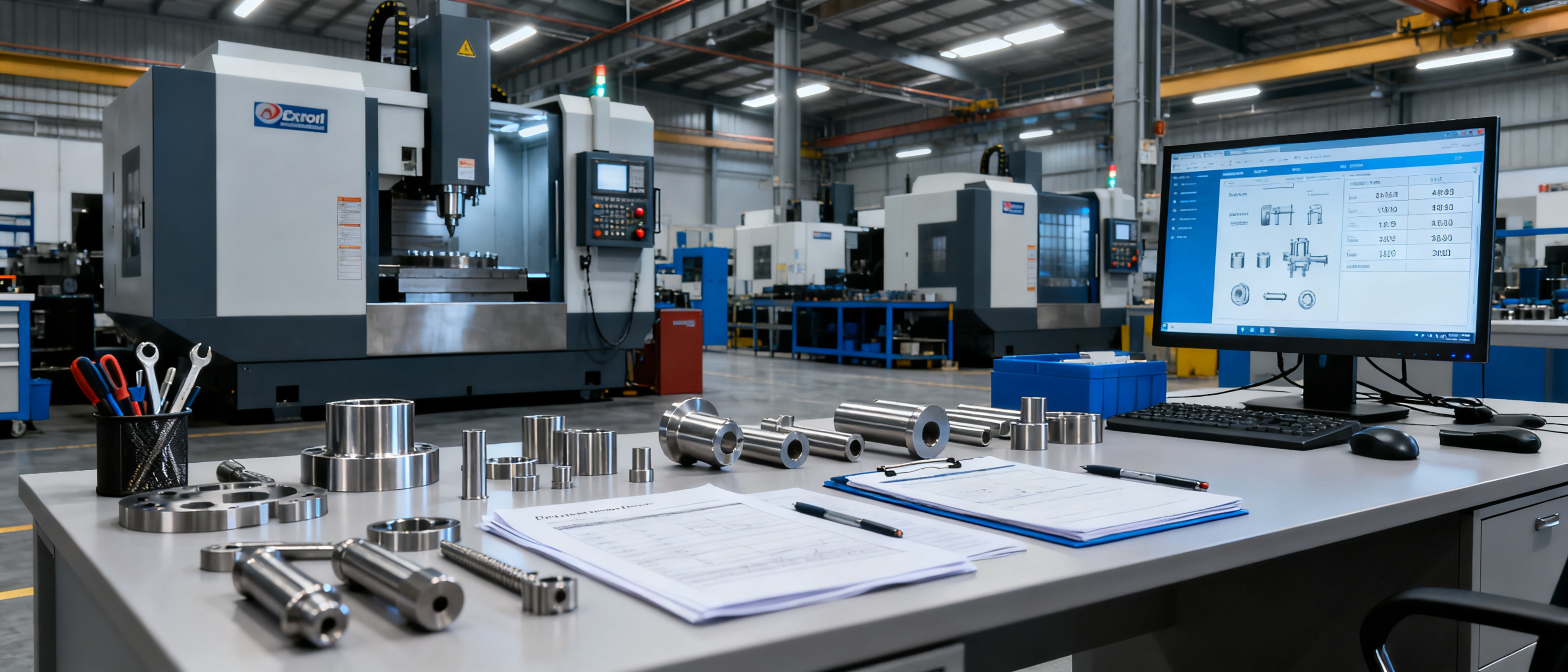
If you run a CNC machining shop and sourcing managers leave your site in under ten seconds, the missing piece is almost always specificity. Buyers scanning supplier pages want to know one thing fast: can you make this part, to this tolerance, in this material, and prove it. This checklist covers exactly what a CNC machining company should put on its website — including machine boundaries, real tolerance data, material and finish ranges, and the proof buyers look for before they ever click "Send RFQ."
Machine List and Capability Boundaries (Not a Brochure)
Generic "we have CNC mills and lathes" copy tells a buyer nothing. A procurement engineer needs to rule shops in or out in seconds based on whether your equipment envelope fits the part. List each machine with four data points: brand and model, number of axes, maximum work envelope (X×Y×Z in mm or inches), and spindle type or max RPM if it differentiates a process.
For example, a Doosan DNM 5700 3-axis with 1050×570×510 mm travels and a 12,000 RPM CAT40 spindle instantly answers the size-and-rigidity question. A Citizen L32 Swiss-type lathe with 32 mm bar capacity and live tooling tells a buyer you handle small, complex turned parts with sub-spindle work. Omitting the work envelope forces the buyer to ask by email — and plenty won't bother.
Equally important is stating your capability boundary. If your largest machine maxes out at 800 mm in X, say so. If you don't do 5-axis simultaneous contouring, don't imply you might. Shops that clearly declare "5-axis positional only (3+2)" build more trust than those that let the buyer guess. Listing a hard boundary — "no parts under 3 mm wall thickness in aluminum without engineering review" — signals that someone inside the shop thought about what they can hold, not just what they can attempt.
- Brand, model, and year for every primary production machine
- Number of axes and whether simultaneous or positional
- Maximum work envelope (travels, not table size)
- Bar capacity for turning centers; max part diameter for lathes
- Any deliberate exclusions: materials, geometries, or tolerances you won't quote
Tolerances and Quality Control Metrics: Numbers, Not Adjectives
"High precision" and "tight tolerances" are the most repeated and least believed phrases on machining websites. A buyer who has rejected batches at incoming inspection reads those words as "we haven't measured our process capability." Replace adjectives with real tolerance ranges tied to specific features and processes.
State your standard machining tolerance — typically ±0.125 mm (±0.005") for general 3-axis work — and your achievable tolerance with added cost and inspection overhead, such as ±0.005 mm (±0.0002") for boring or cylindrical grinding on select features. If you hold true position within 0.05 mm on a production run, put that number on the page. A shop that writes "±0.01 mm on turned diameters under 40 mm" is instantly more scrutable than one that claims "micron-level precision" without context.
Quality control specifics belong here too. Name the inspection equipment: CMM brand and model (Zeiss Contura, Hexagon Global), surface roughness tester, height gauge, optical comparator, or vision measurement system. If you perform in-process probing on-machine, mention it — it signals that inspection isn't an afterthought at final audit. List any statistical process control (SPC) or First Article Inspection Report (FAIR) practices you follow, and whether you ship inspection data with parts by default or on request.
- Standard tolerance band for everyday work (e.g., ±0.125 mm / ±0.005")
- Achievable tight tolerance with surcharge (e.g., ±0.005 mm on specific features)
- GD&T capabilities: true position, concentricity, profile tolerances you routinely hold
- Inspection equipment list with brands and models
- FAIR, SPC, or material certification practices
Materials, Finishes, and Secondary Processes
Buyers filter suppliers by material expertise before they even check pricing. An aluminum extrusion bracket and a Hastelloy valve body demand entirely different tooling, speeds, and chip control. Group your materials by category — aluminum alloys (6061, 7075, 5083), stainless steels (304, 316, 17-4 PH), carbon and alloy steels, engineering plastics (PEEK, Delrin, PTFE), and any exotics like Inconel 718 or titanium Ti-6Al-4V — and be honest about the ones you run daily versus the ones you'll quote but rarely cut.
Surface finishes and secondary processes are conversion-cost items that often decide whether a buyer consolidates with one supplier or splits the order. List anodizing (Type II and Type III), passivation, bead blasting, electropolishing, powder coating, and chem-film by name if you offer them, and clarify whether they're done in-house or through a qualified partner. A buyer who needs black anodize on 6061 wants to see that exact combination on your page, not guess whether "surface treatment available" covers it.
| Material Category | Examples You Run Routinely | Examples You'll Quote |
|---|---|---|
| Aluminum | 6061-T6, 7075-T6, 5083 | 2024, MIC-6 cast plate |
| Stainless Steel | 304, 316L, 17-4 PH | 440C, 2205 duplex |
| Engineering Plastics | Delrin (POM), PEEK, PTFE | Ultem, Nylon 6/6 GF |
| Exotics | — | Inconel 718, Ti-6Al-4V |
Distinguishing "daily" materials from "on-request" ones serves both sides: the buyer who needs 200 Inconel parts knows you'll quote carefully rather than wing it, and you avoid an RFQ for 5,000 PEEK parts when you've only cut it twice. Secondary processes like heat treating, plating, welding, and assembly also earn a spot here — they widen the part scope you can handle without the buyer hunting for a second vendor.
Certifications, Industries, and Real Part Examples
ISO 9001:2015 is table stakes for many buyers, but stating it without supporting proof leaves the claim hollow. If your certificate number and issuing body aren't visible or verifiable, a skeptical procurement manager will ask for the PDF before quoting — or quietly move on. Link to a verification source or display the certificate issuer (TÜV, SGS, BSI, etc.) and scope. Industry-specific certifications carry extra weight: AS9100 for aerospace, IATF 16949 for automotive, ISO 13485 for medical devices. If you hold them, lead with them.
Industry experience matters because a shop that cuts 95% oil-and-gas parts understands NACE MR0175 material requirements by instinct, while a medical-device shop knows burr specifications and passivation standards without being reminded. Name the industries you serve regularly — automotive, medical, aerospace, robotics, semiconductor equipment, food processing — and back each with one or two part examples that make it concrete.
Real part photographs and brief case summaries do more selling than any descriptive paragraph. A photo of a milled manifold with a caption noting "6061-T6, 48-hour turnaround, ±0.05 mm on port positions" gives the buyer a mental template: this shop makes things like what I need. List 3–6 representative parts with material, tolerance, and volume range. Avoid renderings; use real photos even if lighting isn't perfect — authenticity outperforms polish when an engineer is deciding whether to trust you with a $12,000 PO.
- ISO/AS/IATF certification with issuing body and scope
- Industries served with specific part examples per industry
- Real photographs of finished parts (not CAD renders)
- Volume range: prototype (1–10), low-run (50–500), production (1,000+)
- Lead time examples per volume tier
Buyers scanning your page also make split-second judgments about credibility from things you may not think about: whether the site loads cleanly on a phone, whether the domain looks like a real company (not a subdomain of a marketplace), and whether the contact page has a physical address. Google's guidance on creating helpful, people-first content applies as much to an export factory's English page as to any publisher — a page built around real shop-floor data beats a page stuffed with keyword lists every time. The same discipline shows up in Core Web Vitals fundamentals: if your part images take four seconds to appear, the buyer who scans ten supplier tabs has already closed yours.
FAQ
Should a small CNC shop list pricing on its website?
Listing exact per-unit pricing is rarely practical because every part geometry, material, and tolerance stack changes the quote. What does help buyers is a rough order-of-magnitude indicator: an example part with material, quantity, and a ballpark per-unit cost — say, "6061 aluminum bracket, 50 units, ~$22/part." This anchors expectations without committing you to a number that falls apart on the next RFQ. A starting order minimum (e.g., "minimum order $500" or "no minimum on prototype work") is also worth stating up front.
How many photos of machines should a CNC website include?
Enough to show the shop is real, not a trading company with a rented CAD license. Three to five clear shop-floor photos — machines under power, inspection area with CMM visible, organized tooling storage — build more confidence than twenty stock images of clean factory floors. Buyers familiar with machining can spot chip bins, coolant stains, and actual setups in the background, and those details signal a working shop. Include one photo that shows scale, such as an operator beside a large VMC.
Do CNC shops need a separate page for every material and process?
No, and in fact splitting material or process information across too many thin pages often makes a site harder to navigate for a buyer who wants a complete picture in one scroll. A single well-organized capabilities page with clear section headings (Materials, Tolerances, Equipment, Finishes) is far more scannable than eight separate pages each re-stating the same workshop intro. Consolidate until a section grows unwieldy — then split. Most shops under 50 employees can cover everything a buyer needs on two to three core pages.
Should a CNC machining website include an online RFQ form?
Yes, but keep it simple. A form with fields for material, quantity, a rough description, and a file upload for drawings or STEP files removes friction because the buyer doesn't need to compose a formal email from scratch. Avoid requiring twenty fields before submission — that's a form designed to qualify leads internally, not one designed for the buyer who's quoting three shops simultaneously today. A response-time promise ("we reply within one business day with a quote or questions") beside the form raises the chance they'll wait for your number.