2026-09-20
What Pages Manufacturers Should Include in a Website Redesign?
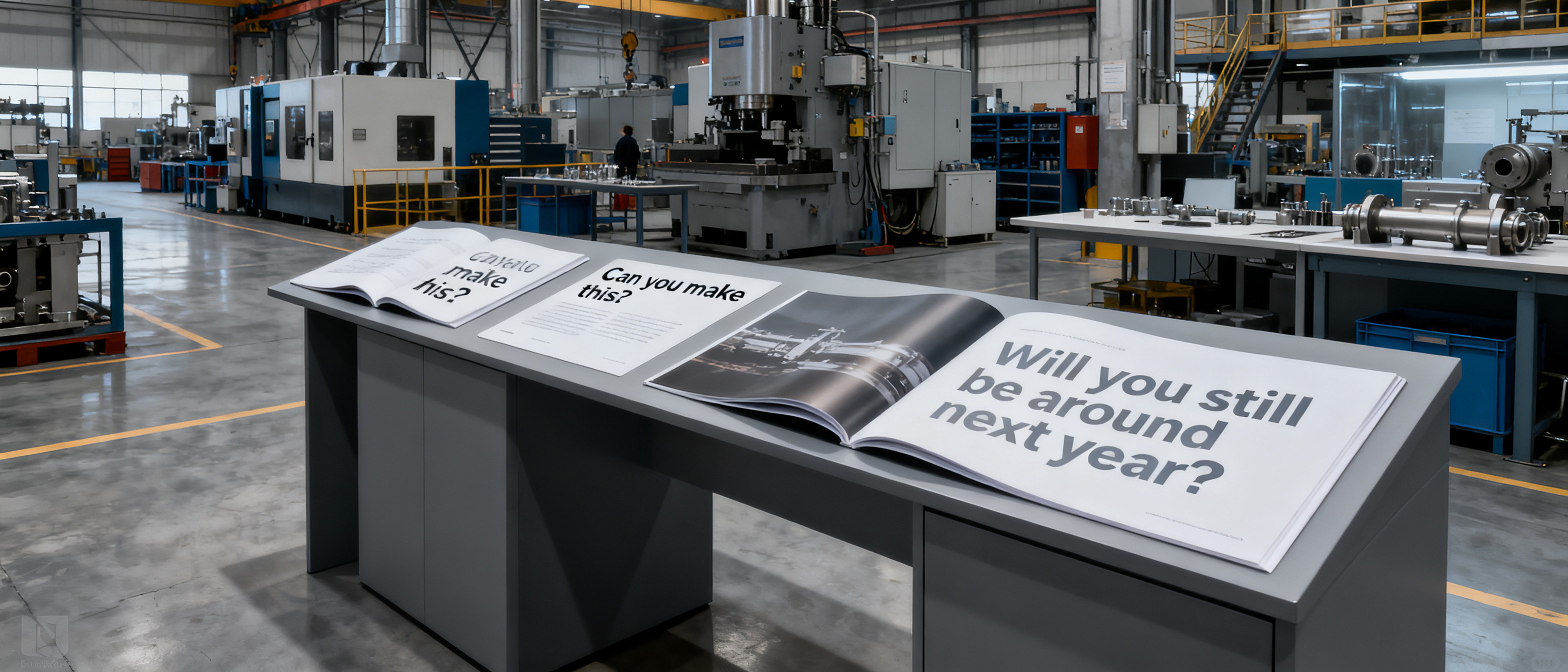
When planning a manufacturer website redesign, the core pages are not about volume. Buyers scanning a supplier site in ten seconds want fast answers to two questions: “Can you make this?” and “Will you still be around next year?” What pages manufacturers should include in their website redesign boils down to five essential pages that deliver those answers without a web team: a clear homepage, a capabilities page, quality credentials, company facts, and a simple inquiry channel. Most factory sites lose potential buyers by burying these truths inside bloated menus or outdated designs. Prioritising these five page types lets export desks and small-B manufacturers turn a thin showcase into a trust signal.
| Page | Buyer’s unspoken question | Essential content |
|---|---|---|
| Homepage | What do you make, and for which industries? | One hero image or video of your product category; 2–3 line value summary; region served |
| Capabilities | Can you produce in my quantities and standard? | Key machines, processes, monthly output ranges, material grades |
| Quality / Certifications | How do you prove consistent output? | List of certificates (ISO, CE, UL), inspection gear, lab capability |
| About / Company Facts | Are you a stable partner? | Years exporting, team size, factory square metres, trade-show participation |
| RFQ / Contact | Can I start a conversation without effort? | Short form, email, WhatsApp link, upload sketch option |
Homepage: The 5‑Second Identity Test – what pages manufacturers should include in their website redesign
A manufacturer’s homepage must survive a ruthless scan. Buyers on Alibaba, Global Sources or IndiaMART click through to an own-domain site to verify the company behind the listing. If the homepage doesn’t instantly show a real production category—metal stamping, plastic injection, textile dyeing—they bounce. Include a single high-impact visual (a clean product photo or short factory floor clip), a three-line description of your core OEM/ODM capability, and the geographic markets you already serve. Avoid carousels that hide the hero message. Google’s page experience signals reward mobile-first simplicity, and a slow homepage loses the mobile buyer who’s comparing three suppliers on a phone during a coffee break. For technical guidance on performance, see web.dev/fast.
- Show the product category and target industry at top, not your company name.
- Limit written text to 30–50 words above the fold; let the visual do the work.
- Add a trust snippet: e.g. “Exporting to 14 countries since 2009” or “ISO 9001 certified workshop.”
Capabilities Page: Machines, Processes, and Volumes That Matter
A capabilities page answers the buyer’s immediate concern: “Can you manufacture this part?” Export factories and small-B manufacturers often hide this information inside a PDF brochure or a phone call. Instead, list your production hardware and tolerances in plain sight. Mention specific CNC models, injection clamping force, laser-cutting bed size, or dyeing capacity per batch. Include typical monthly output (e.g., “50,000 units/month for stamped brackets”) so a procurement agent can quickly gauge fit. If you work with multiple materials—stainless steel 304, ABS, silicone—spell them out. A table comparing process vs. volume vs. lead time helps an engineer scan without emailing.
Quality & Certifications: Proof Beyond a Badge
A JPEG of an ISO 9001 certificate is not enough. Buyers want evidence that your quality system is alive: in-house inspection gear (CMM, tensile tester, go/no-go gauges), documented QC checkpoints, and sample retention. If you hold industry-specific certifications—IATF 16949 for automotive, ISO 13485 for medical, BSCI for social compliance—list them with a short note on what they mean for the buyer’s order. For Chinese export factories, a page that shows real lab photos and an internal audit schedule transforms a badge into credibility. Even a brief explanation of your raw-material sourcing standard (e.g., “All aluminum ingots are 6063 T5 from certified mills”) can differentiate your frontage from a broker.
About / Company Facts: The Legitimacy Layer
Procurement teams often search for “factory audit” signals. A minimal About page that discloses the year the factory started exporting, the workshop square footage, number of engineers, and major trade shows attended (with dates) builds trust without storytelling. Include a photo of the actual production floor—not a stock image—and a link to a verification profile on a platform like Made-in-China or Thomasnet if you have one. Small-B manufacturers in Europe or North America can similarly list founding year, key certifications, and a summary of the supply chain they serve (e.g., “tier‑2 supplier to hydraulic OEMs”). The page doesn’t need a mission statement; it needs verifiable facts that tell a buyer you’ll still be there next year. For practical SEO fundamentals when structuring such pages, refer to Google’s SEO Starter Guide.
RFQ or Contact Page: Remove Friction from Inquiry
Most manufacturer contact pages ask for too much—company name, phone, address, country, product code—while failing to offer a quick way to attach a drawing or photo. The best redesign cuts the mandatory fields to email or WhatsApp plus a message area, and adds an optional file upload. A link that opens WhatsApp with a pre-filled “Hi, I’m interested in custom [part]” message reduces friction for buyers in regions where chat is the default. Do not place a CAPTCHA on the inquiry form; it kills conversion from international buyers on mobile. Provide a clear email address and, if you have one, a link to schedule a call. The goal is to start a conversation that leads to a sample or a video call, not to collect marketing leads.
FAQ
How many pages does a small manufacturer website really need?
A lean, trustworthy website can work with five to seven pages: homepage, capabilities, quality/certs, about, contact, and optionally a dedicated product category page or a FAQ. Many B2B buyers prefer fewer, denser pages over a long menu that hides essential facts.
Should I include pricing and a full product catalog on the site?
Publishing fixed prices is risky in custom manufacturing because material and tooling costs shift. Instead, show approximate volume ranges (e.g., “1,000–100,000 pcs”) and a few representative product images. A downloadable PDF catalog is useful, but avoid loading every SKU into a shopping cart unless you are selling stock commodity components.
How can I prove my factory is legitimate without a flashy site?
Use verifiable facts: your export start date, workshop square metres, machine list, real factory photos, and links to third‑party verification profiles (Alibaba Gold Supplier, IndiaMART TrustSEAL, or a Thomasnet certificate). Even a simple photo of your shipping dock with a recent pallet of boxes builds more trust than a polished homepage.
What if I redesign but still don’t get inquiries?
Once the right pages are in place, focus on directing traffic to them. Link your site in marketplace store descriptions, email signatures, and business card QR codes. A thin frontage works only when paired with consistent outbound sharing. Check that page load times are under three seconds on mobile, and verify that the contact form actually delivers emails to your inbox.
References & Further Reading
- Web.dev – Fast load times and Core Web Vitals for business sites
- Google Search Central – SEO Starter Guide for manufacturer website structure
- Thomasnet – How to create a better industrial website for SMB manufacturers
- ISO – Management system standards and how certifications build buyer confidence
- B2B Frontage Blog – Practical guides on B2B manufacturer frontage without a website team