2026-09-21
OEM Website Design Examples & Tips to Help Increase Leads
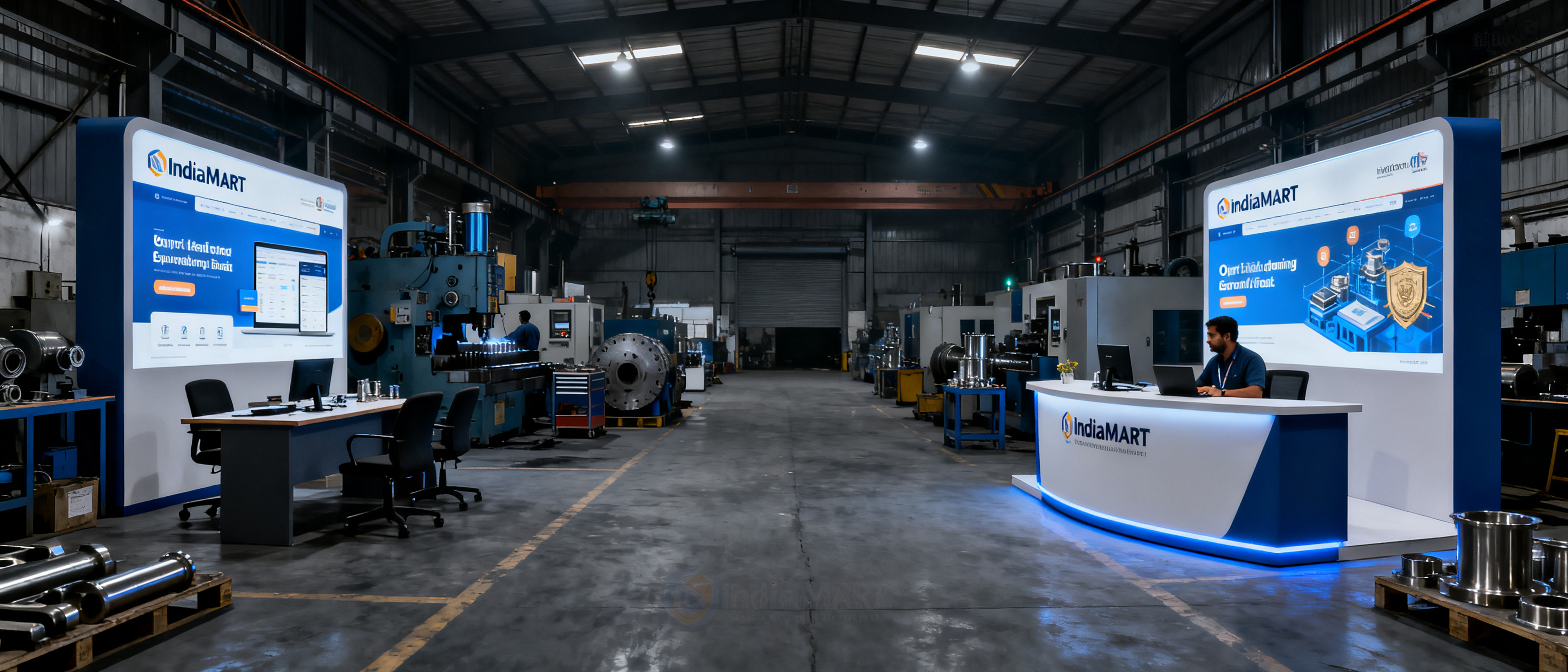
When an export desk or small manufacturer asks for oem website design examples & tips to help increase leads, the core answer is simpler than most assume: design for trust signals and forwarding speed—not visual polish. A buyer who landed on your IndiaMART profile this morning scanned for specs, checked if you looked real, and maybe hit "Send Inquiry." But that same buyer, when asked by their manager "who did you find?", rarely forwards a marketplace URL. They forward a clean, own-domain OEM page that loads fast and puts technical details and an RFQ form one click away. The design examples that actually move leads share three qualities: they surface specs within seconds, they separate serious RFQs from generic "Contact Us" noise, and they stay maintainable without a dedicated web team.
Why OEM Website Design Matters More Than an IndiaMART Profile
IndiaMART handles discovery. Its category taxonomy and buyer dashboards get your product in front of purchasing agents who are actively comparing suppliers. But when that buyer narrows their shortlist to three manufacturers, what do they do? They check if you have an official site, then forward the one that loads fastest and answers their technical questions without forcing a download or a phone call.
A marketplace profile is a listing. An own-domain OEM website is a destination—one that implies permanence, legal registration, and enough operational stability to maintain a public-facing presence. Datanyze surveys on B2B purchasing behavior consistently show that buyers visit a supplier's own website before making contact, even when the initial discovery happened on a platform. If your only web presence is a directory listing with the same template as 200 competitors, you lose on two fronts: perceived legitimacy and forwardability.
The design implications follow from that buyer behavior. An IndiaMART profile can afford to be dense because the platform handles navigation and trust badges. Your own site cannot. It needs to prove you're a real manufacturer within 10 seconds and route the serious buyer to an RFQ form without friction. That's a fundamentally different design brief than "build more pages."
| Lead Factor | IndiaMART / Marketplace Profile | Own-Domain OEM Website |
|---|---|---|
| Discovery reach | High—platform SEO and buyer tools | Lower—relies on your outreach and referrals |
| Buyer trust at decision stage | Moderate (shared platform credibility) | High (independent domain = operational permanence) |
| Forwardability to decision-makers | Low—buyers rarely share marketplace links internally | High—clean domain URLs get forwarded in email and WhatsApp |
| RFQ intent quality | Mixed—high volume, low filter | Higher—visitor already self-selected by finding your domain |
| Maintenance burden | Low (platform-managed) | Varies—can be minimal with managed approach |
The table makes the case for both: platforms supply the top of your funnel; your own domain converts and closes. The OEM website design examples that follow focus on the two elements that move leads from "maybe" to "send me a quotation"—with or without a web developer on payroll.
OEM Website Design Example #1: Navigation That Surfaces Technical Specs Fast
A typical marketplace product page buries specs halfway down, after trust badges, seller ratings, and cross-sell tiles. On your own domain, that logic reverses. The buyer arriving at your site has likely already seen your product category on IndiaMART or Global Sources. They're not browsing—they're verifying. The first design decision that increases leads is a navigation structure that exposes technical data within one scroll, not four.
Consider a sheet-metal fabrication OEM. A lead-driving version of their site places material grades, tolerance ranges (±0.05 mm or ±0.005 in), and available surface finishes in a sticky sidebar that persists across product pages. The buyer doesn't click through five subpages to confirm whether you handle 316L stainless. They see it immediately, trust that you're the real manufacturer, and move to inquiry.
Concrete navigation patterns that work for OEM sites:
- Specs-first product cards. Each product or capability card shows key technical parameters (capacity, material, certification) before any marketing copy. Buyers scan numbers; they read words later.
- Sticky capability sidebar. On desktop, a persistent left or right column lists facility certifications, MOQ ranges, and lead times. This is the digital equivalent of a factory audit summary—visible on every page without reloading.
- Load-speed discipline. If your product images or spec sheets take more than 2.5 seconds to appear on mobile, buyers bounce. Core Web Vitals—particularly Largest Contentful Paint (LCP)—directly correlate with B2B inquiry rates. A fast, text-forward navigation keeps the buyer on-site long enough to hit "Inquire."
These navigation choices aren't about aesthetics. They're about reducing the verification cycle from minutes to seconds. And they work equally well whether your buyer is a European procurement agent or a domestic distributor checking your production range before calling.
Example #2: A Dedicated RFQ Page Instead of a Generic Contact Form
The second oem website design example & tip that directly increases leads is replacing the standard "Contact Us" form with a structured RFQ (Request for Quotation) page. Marketplace inquiry forms standardize this well—buyers attach drawings, specify quantities, and note delivery ports without thinking. OEM websites that replicate that structure on their own domain capture higher-quality leads because the form itself educates the buyer on what information you need to quote accurately.
A generic contact form with name, email, and a free-text "Message" box generates noise. You receive "what's your price?" with no part number, no material, no quantity—emails that require three follow-ups just to become actionable. A dedicated RFQ page solves this with field-level guidance:
- Product/capability selector. A dropdown or multi-select tied to your actual production categories. The buyer self-identifies as needing CNC milling vs. injection molding before they type a word.
- Specification upload field. Accepts PDF, STEP, DWG, or image files directly. Label it clearly: "Upload drawing, sketch, or reference photo (max 10 MB)."
- Quantity and timeline fields. Separate inputs for estimated annual volume and first-order quantity, plus a target delivery date range. These two data points alone filter casual price-checkers from serious buyers.
- FOB or delivery port preference. Critical for cross-border OEM quotes. A single field that captures the buyer's preferred incoterm tells you they understand international trade.
When a buyer fills out five structured fields and attaches a drawing, they've invested real intent. That inquiry arrives warmer than any generic "Contact Us" submission—and your response can open with a targeted quote instead of a clarification loop. This is the single highest-ROI design change an OEM site can make, and it requires no custom development on modern managed platforms.
How to Add These Lead-Increasing Elements Without a Website Team
The objection most export managers and small manufacturers raise at this point is predictable: "We don't have a web person." A machine shop with 40 employees isn't hiring a front-end developer to maintain sticky sidebars or optimize Largest Contentful Paint scores. And they shouldn't need to.
The design examples above—specs-first navigation and a structured RFQ page—are not custom development projects. They are configuration decisions on a platform that already understands OEM requirements. A managed B2B frontage like B2B Frontage gives you those elements without hiring a web person: the navigation is pre-structured to surface technical details, the RFQ form is built for manufacturing inquiries rather than general contact, and the hosting is tuned so page speed doesn't become your problem. The remaining work—supplying your real company information, product categories, certifications, and production line facts—is knowledge you already have.
The operational model that matters here is knowledge once, deploy many times. You record your manufacturer facts (company profile, solutions, optional certs and production lines) in one place. Those facts assemble into your own-domain OEM frontage, a digital card for WeChat/WhatsApp sharing, a downloadable brochure, and short links for email signatures—all from the same source. When your ISO certification updates, you change it once. Every lead-facing asset reflects it. No web team burnout, no stale marketplace profiles with last year's capacity numbers.
B2B Frontage's Auto $59/yr plan bundles a lead-ready OEM showcase with RFQ forms and tech-first navigation—no maintenance burden. That price point matters because it reframes the decision: for less than the cost of one sample shipment, you get an own-domain presence that a buyer can forward to their manager without hesitation. The platforms still bring discovery traffic. Your frontage converts the serious ones.
FAQ
Do I still need my IndiaMART or Global Sources profile if I have my own OEM website?
Yes—platforms and your own domain serve different stages of the buyer journey. Marketplace profiles give you discovery reach and access to buyer dashboards that an independent site cannot replicate. Your own-domain OEM website gives you trust, forwardability, and higher-quality RFQ data at the decision stage. The two work together: buyers find you on the platform, then verify you on your site before inquiring. Maintaining both is not duplication; it's funnel coverage.
How much does a basic lead-optimised OEM website cost per year?
A managed OEM frontage with RFQ forms, specs-first navigation, and own-domain support starts around $59–$150 per year on platforms designed specifically for manufacturers. Custom WordPress builds with equivalent functionality typically run $800–$3,000 upfront plus ongoing maintenance fees. The cost difference comes down to whether you're paying for development hours or for a pre-configured manufacturing template that you populate with your own facts.
What makes an RFQ form different from a regular contact form, technically?
A structured RFQ form includes field types and validation logic specific to manufacturing inquiries: file upload fields for technical drawings (accepting STEP, DWG, PDF), quantity range selectors with MOQ guidance, material grade dropdowns, and incoterm preference fields. A generic contact form lacks this structure, so you receive free-text messages that require multiple clarification emails before they become quotable. The RFQ form pre-qualifies by design.
Can I connect my existing domain to a managed OEM website platform?
Most managed OEM website services support custom domain connections. You can point your existing domain (e.g., yourfactory.com) to the managed frontage, and the platform handles SSL certificates and DNS configuration. This gives you the credibility of an independent domain without managing hosting infrastructure. Always confirm domain support before subscribing—some entry-tier plans may require a specific upgrade tier for custom domain mapping.
How fast does an OEM website need to load to avoid losing leads?
Google's Core Web Vitals research indicates that pages loading within 2.5 seconds (Largest Contentful Paint) retain significantly more visitors than slower alternatives. For B2B OEM sites accessed on mobile by buyers in regions with variable connectivity, sub-3-second load times are critical. Every additional second of load time can reduce inquiry conversions by 7–10%, based on aggregated e-commerce and B2B conversion data. A text-forward design with optimised images and minimal JavaScript keeps you safely inside that threshold.
References & Further Reading
- B2B Frontage Blog — OEM website guides and manufacturer marketing insights
- Google Search Central — Creating Helpful, Reliable People-First Content
- web.dev — Core Web Vitals and business impact on user experience
- Statista — B2B E-Commerce: global market data and buyer behavior trends
- Next.js — Performance optimization documentation applicable to B2B site architecture